
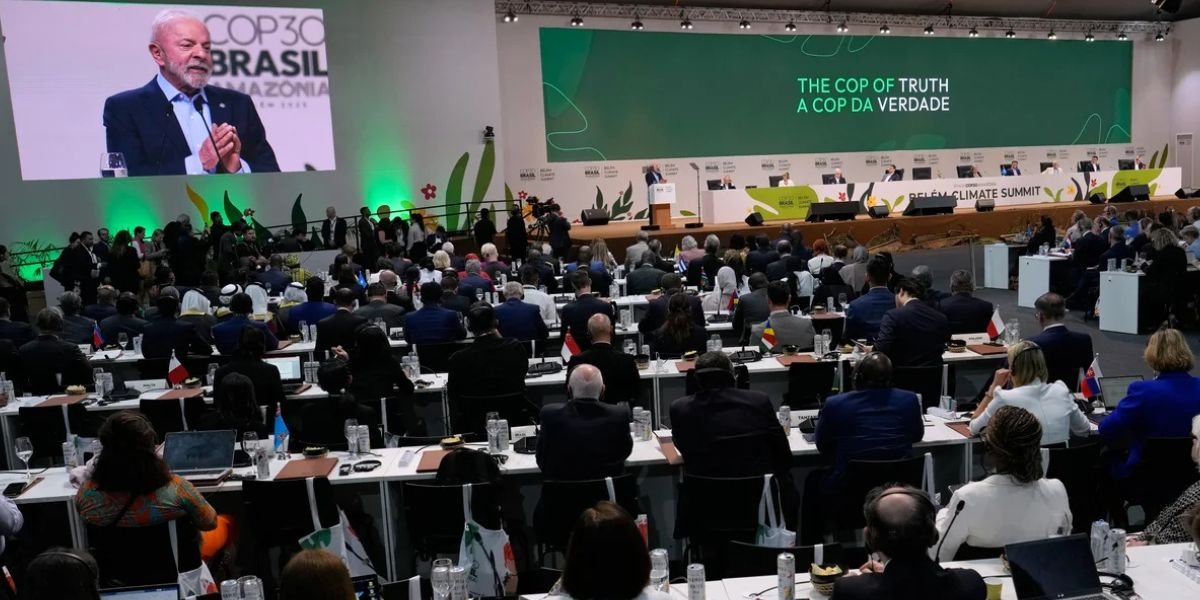
The absence of President Donald Trump from the COP30 Climate Summit, held from November 6–17, 2025, in Belém, Brazil, was more than a diplomatic misstep; it was a symbolic abandonment of global responsibility. Democratic leaders in Washington openly criticized the move, calling the empty American seat “a historic humiliation for the United States.” In a press conference held the day the summit opened, they lamented that America had “vacated its seat at the head table,” leaving the world’s most important climate forum without representation from the leader of the world’s largest historical emitter. Trump’s choice to skip the summit—and send only a symbolic, understaffed delegation—reflected not only neglect but a deeper rejection of science, global consensus, and leadership.
The 2025 COP30 summit is one of the most significant climate gatherings since the Paris Agreement, drawing prominent world leaders shaping the future of global environmental policy. The summit was inaugurated by Brazil’s President Luiz Inácio Lula da Silva, alongside UN Secretary-General António Guterres, Chinese President Xi Jinping, French President Emmanuel Macron, German Chancellor Olaf Scholz, UK Prime Minister Keir Starmer, Canadian Prime Minister Justin Trudeau, European Commission President Ursula von der Leyen, and leaders from nearly every major Asian, African, and Latin American nation. Their presence underscored the urgency of the global climate crisis. The only major world leader missing was Donald Trump.
Trump’s stance on climate change remains rooted in denial. He has dismissed established climate science as “nonsense,” called global warming a “hoax,” and repeatedly undermined research from NASA, NOAA, the IPCC, and even the U.S. Department of Defense. His administration rolled back more environmental regulations than any in modern American history—more than 125 rules—while opening federal lands for drilling, weakening renewable energy incentives, and dismantling key climate programs. While the world accelerates efforts against climate change, the United States under Trump continues to retreat.
This absence is particularly alarming because the climate crisis is worsening faster than predicted. Global temperatures have risen 1.3°C above pre-industrial levels. Sea levels are climbing at more than 4.5 millimeters per year. Extreme weather killed over 60,000 people in 2024, with devastating floods, wildfires, storms, and heatwaves across every continent. Major global cities—Miami, New Orleans, Jakarta, Lagos—face recurrent flooding. Air pollution kills 7 million people annually. And the ozone layer, while recovering, remains vulnerable due to increased emissions of unregulated chemicals.
Yet Trump chose not to attend the very summit where world leaders committed unprecedented political and financial resources to combat global warming. Nearly 190 nations reaffirmed climate change as “an existential threat to humanity,” pledging to accelerate decarbonization, expand climate financing, and invest in resilient infrastructure. China, often blamed by Trump as the “world’s polluter,” presented the strongest plan—expanding renewable capacity to 5,000 gigawatts by 2030, investing $900 billion in green technology, and reaffirming carbon neutrality goals. Ironically, the nation Trump criticizes most is now leading the global transition.
Europe demonstrated similar resolve. The EU declared climate change “the defining security challenge of the 21st century.” Germany committed to shutting down all coal plants by 2030. France announced massive solar and nuclear expansion. The UK accelerated its electric vehicle transition, planning to end combustion engine sales by 2032. Canada pledged billions toward green hydrogen and Arctic protection. The contrast is stark: while the world views climate change as a battle for survival, the United States under Trump is stepping aside.
America’s withdrawal is part of a broader pattern—retreat from global institutions such as the WHO, UNESCO, UNHRC, and WTO. U.S. influence has diminished not because of lack of power but because of policy decisions that appear confrontational or narrowly self-serving. As a result, Washington is increasingly isolated in major diplomatic arenas.
Trump’s domestic agenda deepens the divide. His administration reopened financing for coal, granted thousands of oil and gas permits, expanded offshore drilling, and discouraged electric vehicle adoption through policy reversals and tariffs. While China is on track to sell more than 11 million EVs in 2025, the U.S. market faces stagnation.
Meanwhile, renewable energy has become the cheapest power source in history. Solar costs have fallen 89 percent in a decade, and wind costs by 70 percent. Global solar installations now exceed 400 gigawatts annually—more than the total U.S. coal fleet. If America continues to delay, it risks losing economic competitiveness for an entire generation.
Inside the United States, resistance to Trump’s climate policies is growing. Governors, mayors, scientists, universities, and corporate leaders have reaffirmed their commitment to the Paris Agreement. At COP30, several U.S. senators said Trump’s absence “damages U.S. credibility and weakens national security.” Images of the empty U.S. seat went viral, symbolizing a superpower turning away from global responsibility.
America once led the world in environmental policy. It helped craft the Paris Agreement, built climate financing structures, and steered international emissions reduction efforts. That legacy is now under threat. Trump’s choices not only endanger the planet but undermine America’s strategic interests. A nation that once led from the front is missing at a moment of greatest global need.
The United States must reevaluate its path before the consequences become irreversible. It must return to clean energy innovation, rebuild environmental institutions, invest in a green workforce, and restore its leadership across global climate forums. If it waits too long, leadership lost today may never be regained as the world accelerates into a clean energy future.