Former CIA analyst Larry Johnson recently argued that Israel’s intelligence agency, Mossad, has maintained a longstanding covert relationship with certain Baloch militant elements operating along the Pakistan-Iran border.
Referring to allegations that have previously appeared in Western media, Johnson stated that Israeli operatives had allegedly recruited Baloch militants while posing as American intelligence officers to conduct operations inside Iran.
Building upon that historical episode, he further argued that the recent surge in militant attacks in Pakistan’s Balochistan province should not be viewed as isolated acts of violence but as part of a broader geopolitical strategy designed to generate instability simultaneously in Pakistan and Iran.
Johnson’s remarks have reopened an important debate regarding the wider geopolitical dimensions of the Baloch conflict.
Having spent more than six decades living in Balochistan, I find Johnson’s assessment worthy of thoughtful consideration— because it raises questions that deserve careful examination.
I was born in Quetta and have witnessed every major phase of the province’s insurgency. Governments have changed, military operations have come and gone, peace agreements have been negotiated and abandoned, but the insurgency that exists today is fundamentally different from those witnessed in previous decades.
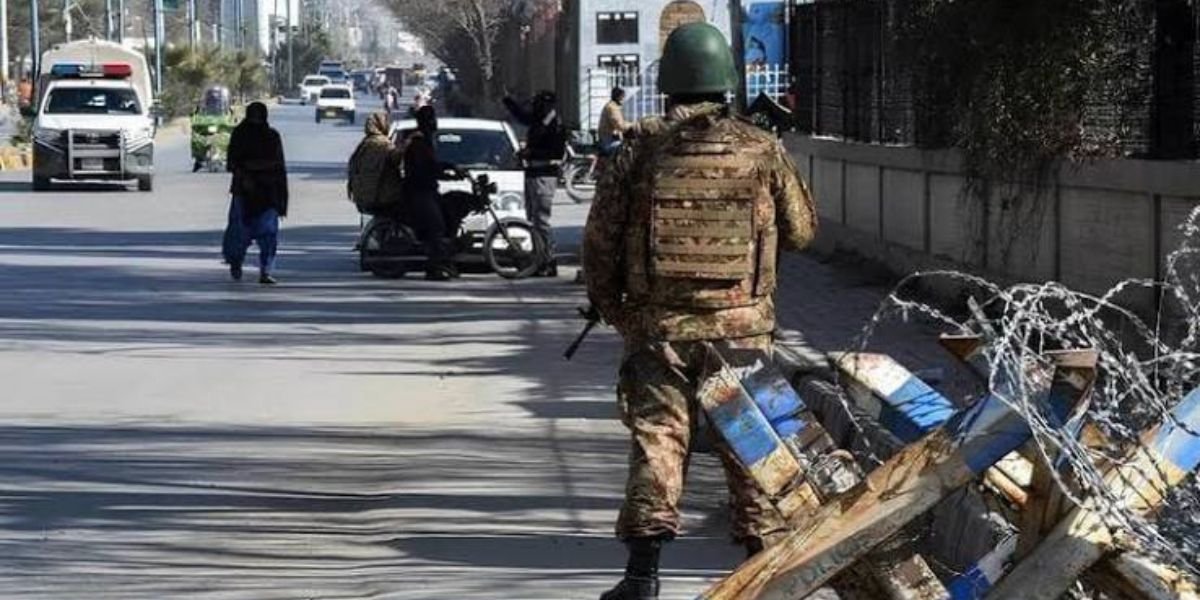
It is more sophisticated, more disciplined, more lethal, and considerably more capable of executing coordinated attacks across vast distances. Militants today employ sophisticated communications, modern weapons, intelligence gathering, coordinated logistics, and operational planning that naturally raise questions regarding the origin of such capabilities, and inevitably encourages analysts to examine not only domestic grievances but also wider geopolitical influences.
For anyone who has lived in Balochistan, recurring insurgency is neither surprising nor new. However, I believe the present insurgency cannot be understood solely through the prism of local grievances.
It increasingly appears connected to broader strategic and ideological competitions unfolding across South Asia and the Middle East. Regional conflicts seldom remain purely local; they often become the meeting point where domestic vulnerabilities intersect with external geopolitical interests.
One analytical framework begins with the concept of Akhand Bharat, an ideological current associated with Hindu nationalist thought that envisions the reunification of territories that historically formed part of undivided India.
This construct has influenced elements of India’s long-term strategic outlook. Within that framework, Pakistan represents the principal geopolitical obstacle to India’s emergence as the dominant power of the subcontinent. Consequently, a politically fragmented or internally weakened Pakistan would naturally be viewed as strategically advantageous.
Another analytical framework is the concept of Israel’s long-term strategic thinking of greater Israel that has consistently emphasized preventing the emergence of regional powers capable of challenging its military superiority or strategic freedom of action.
Viewed through that analytical lens, Pakistan occupies a unique position as the only Muslim-majority nuclear-armed state possessing substantial military capabilities and expanding defense cooperation with several Muslim countries. According to this interpretation, Pakistan inevitably figures within broader regional strategic calculations.
The motivations of Israel and India may or may not be entirely independent of one another. Yet history demonstrates that different states pursuing separate interests can nevertheless generate outcomes that reinforce one another without operating through a common plan.
India may pursue policies that serve what it considers its own regional interests, while Israel may independently pursue policies consistent with its own security doctrine.
If both sets of policies contribute, intentionally or otherwise, to increasing pressure on Pakistan’s internal cohesion, the cumulative effect may appear complementary despite the absence of direct coordination.
Viewed from this perspective, Pakistan’s internal fault lines become strategically significant. The former Federally Administered Tribal Areas, because of their frontier with Afghanistan and decades of militant activity, remain vulnerable to external influence.
Balochistan presents an equally attractive arena because of its immense geography, sparse population, strategic coastline, Gwadar Port, abundant mineral resources, and borders with both Iran and Afghanistan. Any instability in these regions inevitably carries consequences extending far beyond provincial politics.
Pakistan’s armed forces possess decades of experience in counterinsurgency and asymmetric warfare. From the Soviet-Afghan conflict through successive campaigns against militant organizations, Pakistan has accumulated considerable institutional expertise. Yet despite these capabilities, the Baloch insurgency has endured.
That reality demonstrates a lesson repeatedly confirmed by history: insurgencies are rarely defeated through military force alone. Tactical victories may suppress violence temporarily, but unless political grievances are addressed, conflict often regenerates.
Pakistan has recently demonstrated significant military capability in confronting external security challenges and conducting operations against militant networks along its western frontier. The determination shown by its security institutions reflects the seriousness of the evolving threat. Nevertheless, military success should become the foundation for political reconciliation rather than a substitute for it.
The responsibility for initiating lasting peace rests primarily with the state because governments possess constitutional legitimacy, institutional authority, and the capacity to implement reforms that insurgent organizations cannot.
This observation does not excuse attacks upon civilians or security personnel. Rather, it recognizes that durable peace emerges when effective security is accompanied by statesmanship, political inclusion, and justice.
A sustainable settlement for Balochistan should therefore combine firm security with meaningful dialogue, accelerated economic development, improved education and healthcare, transparent governance, equitable sharing of natural-resource revenues, greater provincial participation in national decision-making, and constitutional guarantees that strengthen public confidence in the federation.
History repeatedly demonstrates that governments and insurgencies eventually return to negotiations after years of costly confrontation. The tragedy is not that negotiations occur, but that they often begin only after immense human suffering and economic destruction. Every bombing deepens mistrust. Every military operation creates new wounds. Every family that loses a loved one carries scars that persist long after the fighting ends.
After observing Balochistan’s turbulent journey for more than six decades, I remain convinced that neither perpetual confrontation nor military victory alone can secure the province’s future. If external actors are indeed seeking to exploit Pakistan’s vulnerabilities, Pakistan’s strongest response lies not only in military preparedness but in building a politically cohesive, economically prosperous, constitutionally inclusive, and socially united nation.
Ultimately, this is the lesson for both the Pakistani state and the insurgents. Violence, regardless of who employs it, cannot build a stable society. Governments possess greater responsibility because they possess greater authority.
They must lead the path toward reconciliation, address legitimate grievances through constitutional means, and isolate only those committed to terrorism. Those who have taken up arms must likewise recognize that no enduring political objective can be achieved through bloodshed.
Balochistan has buried enough sons, sacrificed enough generations, and endured enough cycles of violence. The insurgency has inflicted immense suffering on the province itself. Baloch militant groups have killed numerous security personnel, targeted innocent civilians, brutally murdered workers and travelers from other provinces, and destroyed roads, railways, communication networks, and other public infrastructure essential for the province’s development and the well-being of its people.
The state, too, has paid a heavy price in lives, resources, and public trust while striving to restore order. Continued violence—whether committed by insurgents or in the course of armed confrontation—has only deepened wounds, delayed development, and prolonged the suffering of ordinary Baloch citizens.
The future of Balochistan should not be determined by bullets, by mutual mistrust, or by the strategic ambitions of outside powers. It must instead be built upon dialogue, justice, constitutional inclusion, economic opportunity, and national unity. History repeatedly teaches that even the longest and bloodiest conflicts ultimately end at the negotiating table. Wisdom lies in reaching that table before another generation is consumed by war.