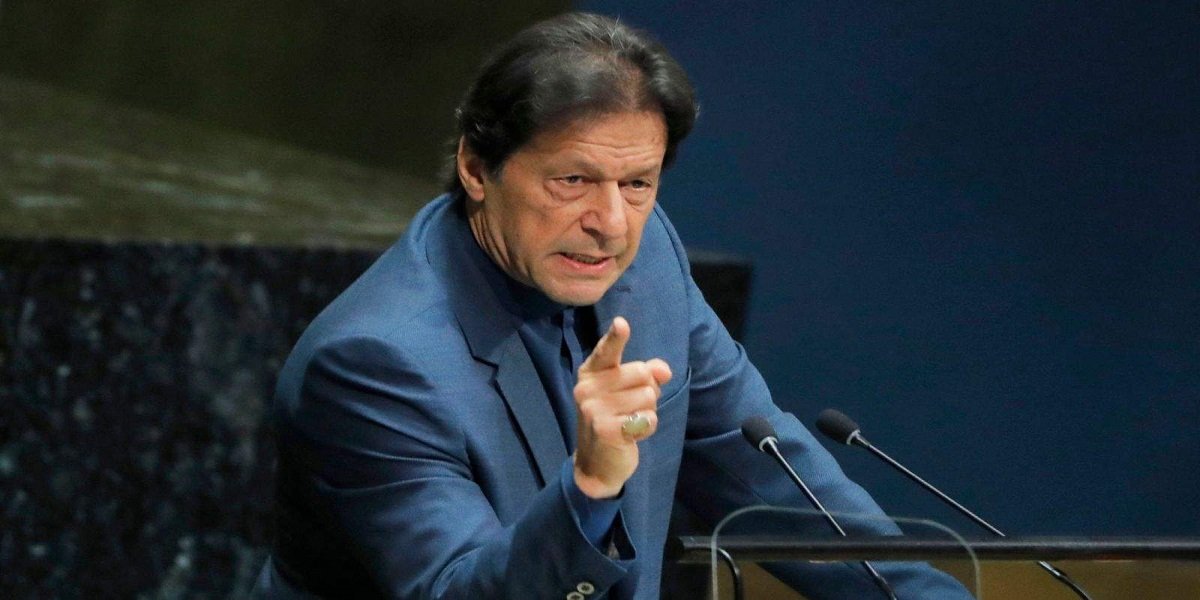
The top brass of the Pakistan Muslim League (N) has been labeling Imran Khan a “Fitnah,” which essentially is a term that refers to a process rather than a person. Declaring Fitnah in Islam necessitates strong evidence, clear intent, consultation with knowledgeable individuals, and a fair and just approach. This would attract penal action for labelling someone or a process as Fitnah without first having a competent forum declare it as such.
I personally believe PML(N) does this out of ignorance, or even a desire to belittle the former Prime Minister at all costs. They aim to reduce his larger-than-life size, and transfer this hatred to their followers by exploiting their religious sentiments without having the slightest idea of Fitnah’s connotation, historical reference to the context, and its consequences and outcome. They even vowed to rid the country of this fitnah, which indicates either dysfunctioning him or depriving him of his life. This extreme hatred is understandable given that he was the primary reason for first crippling the government in 2014. His prolonged sit-in jointly with PAT severely weakened it, which helped him less and more to the establishment and further tightened its grip on civilian affairs. Later, the PML(N) ouster from power in 2018 was allegedly executed by riding on the shoulders of the establishment, which even Imran had never denied in so many words.
When in power, with the blessing of the establishment and the tacit support of the courts, Khan imprisoned almost the entire top PML(N) leadership one after the other on unproven charges. He was the driving force behind Mr. Nawaz Sharif’s imprisonment and later his exile to London.
After being thrown out of power in 2022 due to an alleged international conspiracy, PTI Chairman’s successful narrative of Haqiqi Azadi – with his hawkish attitude towards the establishment and court as and when suits him – successfully eroded the support of PML(N) in its stronghold and richest province, Punjab. For them, Imran is a great threat, a menace and perhaps the only challenge to the hold of their family on the powerbase of the country. He emerged as a formidable opponent having grit, tenacity, and determination to stand against all odds.
In doing so, he has mustered massive public support which perhaps none of us have witnessed in our living memories. His ardent and devoted followers are willing to sacrifice their lives to defend him if it comes to that – an unparalleled phenomenon where an unarmed crowd staunchly defended his arrest by a heavy contingent of police and rangers. These are perhaps the reason the establishment associates this hateful and obnoxious term of Fitnah to him.
Before going any further, let us try to understand the word “fitnah”. It is an Arabic term used to describe disorder, chaos, or temptation but at times it has been subject to different interpretations by Islamic scholars and leaders.
Variations of the usage of fitnah are found throughout the Quran to describe the trials and temptations that believers may face: “And know that your worldly goods and your children are but a trial and a temptation [fitnah], and that with Allah there is a tremendous reward” (8:28). “They said: ‘In Allah do we put our trust. Our Lord! Make us not a trial [fitnah] for those who practice oppression'” (10:85). “Every soul shall have a taste of death. And We test you by evil and by good by way of trial [fitnah]. And to Us you must return” (21:35). “Our Lord! Make us not a test and trial [fitnah] for the unbelievers, but forgive us, our Lord! For You are the Exalted in Might, the Wise” (60:5). “Your riches and your children may be but a trial [fitnah], but in the presence of Allah, is the highest reward” (64:15).
In historical perspective, this term is used to justify political repression or persecution of dissidents, while others have argued that it has a legitimate role in maintaining social order and preserving Islamic values. It describes a particular state of consciousness of protesting participants, and determines the state of society affected by the turmoil that occurs at a time of resignation of the unwanted ruler.
There are mainly four fitnahs particularly mentioned in the Islamic history. The Fitnah of the Kharijites (656-661) was the major fitnah that occurred in the early Islamic period when a group of Muslims rebelled against the ruling authorities, declaring them as corrupt and deviant. This tribulation led to a lot of bloodshed and division within the Muslim community. The second Fitnah followed Muʿāwiyah’s caliphate (661–680), which itself was not free from strife, and coincided with the caliphates of Muʿāwiyah’s son Yazīd I (ruled 680–683). The third Fitnah (744–750) resulted in the establishment of a new and final dynasty of caliphs, the ʿAbbāsids which was marked with several instances of political unrest and rebellion where Abu Muslim lead rebellion against the Umayyad caliphate and culminated in the ascendancy of the Abbasid dynasty. The fourth Fitnah occurred when Hārūn died and Al-Maʾmūn came to the caliphate (813–833) after winning the bloody war of ascendancy. In the 20th century various political and social upheavals which occurred in the Muslim world are termed Fitnah including the fall of the Ottoman Empire, colonization by European powers, and the rise of extremist movements like Al-Qaeda and ISIS. These fitnahs have had a profound impact on the Muslim world and have led to ongoing debates about the relationship between Islam and modernity.
According to various studies in Islam, a person may be severely punished only if the conduct in question amounts to blatant disbelief (kufr sarfi) but forbids the use of coercion by those seeking to spread the faith. It also takes measures to protect Muslims against aggression that would deny them their own freedom. As used here, fitnah is antithetical to freedom of religion and can claim no validity under any legitimate concept and variety of freedom (Ghazawi n.d.).
In the context of politics, fitnah arises only when the government in power believes that someone is interpreting Islamic values differently than those practiced by it. It could also arise when any group in the public believes that the government is not acting on the righteous path, is violating Islamic principles, and is propagating non-Islamic values in their personal conduct – by imposing non-Islamic laws, rules, or regulations. Surprisingly, in all of these documented cases, Fitnah eventually resulted in a change in the seat of government until a new fitnah emerged.
Let us try to comprehend what Imran Khan is requesting. His main demand is that free, fair, transparent, and verifiable elections be held. This is because, according to him, the government has no legitimacy and has been propped up as a result of an internationally hatched conspiracy. He adds that it is incompetent, and lacks the wherewithal to deal with the daunting financial and economic challenges. The economy has nosedived, and so has its currency. The international donor institution has lost faith in the government, and friendly countries have expressed their sympathy but are unwilling to help the country out of its dire economic situation. Pakistan is experiencing hyperinflation – businesses and industries are closing due to a lack of raw materials, high utility prices, exorbitant taxes and high cost of borrowing capital. Economic activity is at a low ebb as a result of high prices and people’s dwindling purchasing power. According to him, the solution to this quagmire is the installation of a fully legitimate and credible government mandated by the people to steer the country to safer shores and usher the country to much needed political stability. This will persuade donor agencies, friendly and brotherly countries, and investors to come to Pakistan and help stabilize the country’s financial and economic outlook. His entire rhetoric is based on political expediency and bears no religious connotation.
In his personal conduct, behavior or speeches, he has shown no sign of defying any religious beliefs, values, or practices. He never used religion as a weapon against the current government, nor did he base his political narrative on religious motives. His religious credentials are head and shoulder above any other politician in our country or any other Muslim leader. He is a practicing Muslim who lives a pious life and fights against “Islamophobia” all over the world, bravely opposing the desecration of the Holy Quran. He is vocal about the publication of blasphemous cartoons of the Prophet Muhammad (PBUH) in all national, regional, and international forums. Due to his efforts, the entire world observed International Day to Combat Islamophobia on March 13th. Similarly, in terms of humanitarian services, he has no rival who comes close to matching his philanthropic achievements. It is worth noting that not a single opposition leader has charged him for defying religious beliefs, customs, or practices, with the exception of confronting his past life, for which he has already repented and shown remorse.
The recent confrontation of Khan’s supporters with the brute state power cannot be called as rebellion or Fitnah. The state in guise of serving arrest warrants in compliance to the court orders instead of observing the laid down rules for services of warrants, invaded his residence with excessive forces. However, Imran’s supporters gave them a tough fight and successfully frustrated every effort of the government to arrest him until Islamabad High Court suspended the warrant. This gave him time to appear before the trial court to which he agreed. The orders of the high court vindicated the legality of the resistance and rendered the state’s use of brute power as illegal.
With the foregoing in mind, PML(N) may call him anything which is within our cultural and social parlance and politically correct, while they rethink the use of the word Fitnah. It mainly refers to the struggle of a person or group of persons against the rulers which according to them are not following the true tenet of Islam and promoting non-Islamic values in the society through state patronage. Moreover, his personal conduct as a practicing Muslim is unquestionable. His services to Islam and its cause are praised and acknowledged worldwide, and his philanthropic work is unparalleled. His entire critique and narrative of the government is purely political. He is pursuing his vision and objectives using universally accepted political tools, and he is, above-all, loved by his followers and admirers who are willing to sacrifice their lives and property in his political struggle.
The government and the PML(N) have every right to use any or all political tools at their disposal to give Imran Khan a hard time, and they may consider using any other term to express their heartfelt feelings for him, but not Fitnah, which has more of a religious connotation than a political one and is normally a struggle waged against the state due to its perceived moral turpitude and patronage of non-Islamic ways of life, which I believe is not the case here. Furthermore, public pledges and vows to kill him may be politically and religiously insensitive. He is fighting a political battle for his vision of Pakistan, whether right or wrong, and it may be more appropriate to fight him out and defeat his political vision and him with a better vision and service. Now that the PML(N) is in power, it should focus its energies and collective wisdom, intellect and experience, competency and acumen to bring the country out of its formidable financial and economic woes. This may neutralize his narrative and him, better than any other manner, no matter how strong and appealing. (Edited by Khadijah Kamili)
(The views in this article are solely representative of the author’s perspective.)
Also Read: Imran sees Minar-e-Pakistan’s power show ‘referendum against violence’