By Zakir Baltistani
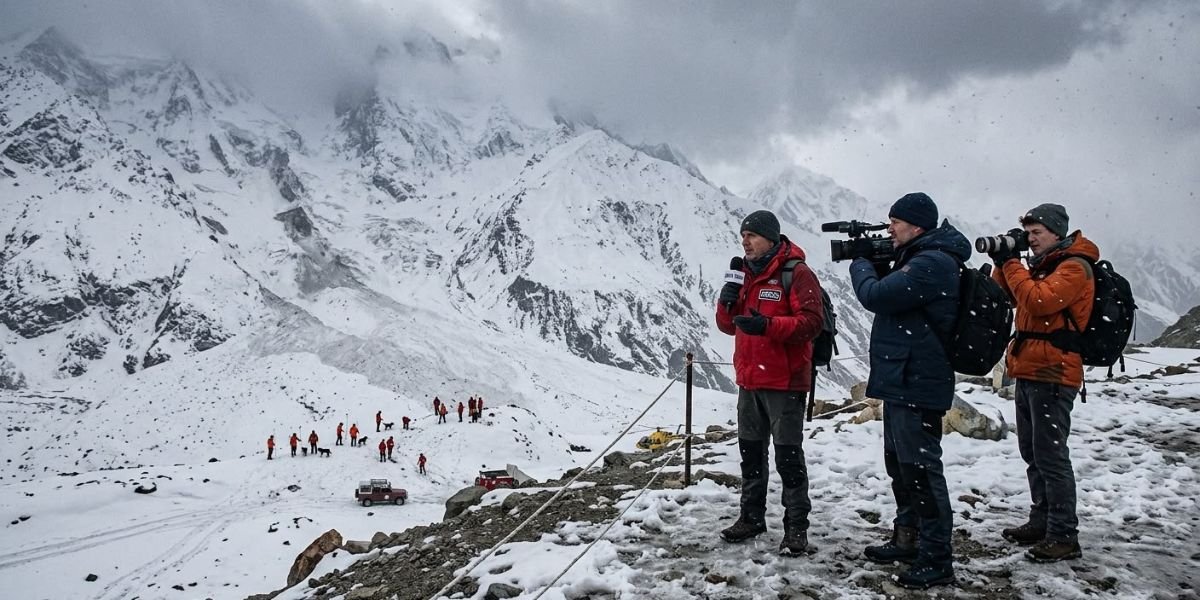
For a few terrifying moments, Mohammad Hussain Azad believed he might never make it home alive. He was covering the aftermath of the 2012 Gyari avalanche near Siachen, alongside other journalists, when another mass of snow suddenly began rushing toward them. Within seconds, thick clouds of snow engulfed the area, reducing visibility to almost nothing for nearly ten minutes.
“At that moment, I thought there was no way we would survive,” recalls Azad, the Skardu correspondent for Dunya News.
Fortunately, the avalanche plunged into a deep ravine before reaching the journalists, sparing their lives. But the incident left Azad with a sobering realization: journalists covering natural disasters in Gilgit-Baltistan often risk their own lives to keep the public informed, yet their own safety remains largely overlooked.
Climate Change and Growing Risks
Gilgit-Baltistan is among Pakistan’s regions most vulnerable to the impacts of climate change. According to reports published in 2022 and 2023 by the Pakistan Meteorological Department (PMD), the Gilgit-Baltistan Disaster Management Authority (GBDMA) and the United Nations Development Programme (UNDP), the region is home to more than 7,000 glaciers and over 3,000 glacial lakes. Many of these lakes have been identified as being at risk of Glacial Lake Outburst Floods (GLOFs)—sudden floods that occur when water trapped behind a glacier is abruptly released, sending destructive torrents downstream.
These floods can wash away villages, roads, bridges and farmland within minutes.During Pakistan’s devastating floods in 2022, dozens of glacial lake outbursts and landslides were reported across Gilgit-Baltistan, causing extensive damage to infrastructure and local communities. Climate experts warn that rising temperatures are accelerating glacier melt, making such disasters increasingly frequent and severe.
‘Every Assignment Comes with the Fear of Death’
For Azad, reporting on natural disasters is one of the most dangerous beats in journalism.
“Disasters strike without warning. There is no time to prepare. Every moment in the field comes with the fear that something could go terribly wrong,” he says.
When he covered the Gyari avalanche in April 2012, neither he nor his colleagues had any personal protective equipment, nor had their media organizations made any special safety arrangements.
“The Pakistan Army arranged our transport, accommodation and basic security. As far as our media organizations were concerned, safety provisions were almost non-existent.”
Breaking News at Any Cost?
For journalists covering natural disasters in Gilgit-Baltistan, the danger does not come from floods, landslides or avalanches alone. Poor communication infrastructure and the pressure to deliver breaking news often make an already hazardous job even more risky.
Azad says many remote areas, including Shigar Thang, Shigar, Khaplu and other mountainous regions, still have little or no mobile phone or internet connectivity.
“Newsrooms expect immediate coverage and constant updates, but many disaster-hit areas have no network at all. If something happens to us, calling for help can be nearly impossible,” he explains.
According to local journalists, there are no clearly defined safety protocols for reporters injured while on assignment, and insurance coverage is either limited or entirely absent.
“Most of the time, we rely more on courage than on training,” Azad says.
When Journalists Become Part of the Story
Mohammad Hussain Azad’s experience is far from unique. Over the years, several journalists in Gilgit-Baltistan have found themselves caught in the very disasters they were covering. One such incident took place in August 2016 at Ghowari Nullah in Ghanche District. Four journalists—Qasim Butt of Aaj News, Mohammad Imran of PTV News, Wazir Muzaffar of GNN News, and another colleague—had travelled to the area to report on flash floods.
Following completing their coverage and beginning their return journey, they were suddenly confronted by a massive torrent of mud, boulders and thick dust racing down the valley within moments, reporting was no longer their priority—survival was. Local residents rushed to help and managed to move the journalists to safety. Some sustained minor injuries, but all escaped with their lives. Looking back, the journalists say the incident taught them how quickly disaster reporting can turn deadly.
“Sometimes, the people covering the disaster become victims of it themselves,” one of them recalls.
A Narrow Escape at Sadpara Dam
Another close call occurred near Sadpara Dam in Skardu after a glacier burst triggered a sudden flash flood.
Express News reporter Mohammad Afzal and his team were standing near the dam, filming the aftermath, when a powerful surge of water, rocks and debris suddenly came crashing down the mountainside.
Realizing the danger, Afzal ran for higher ground. He managed to escape the floodwaters but became trapped among large rocks while trying to flee, suffering serious injuries.
Local residents and rescue workers later pulled him to safety and rushed him for medical treatment.
Reflecting on the incident, Afzal says it fundamentally changed his understanding of disaster reporting.
“In natural disasters, conditions can change within seconds. Without proper safety training and protective equipment, even a small mistake can become fatal.”
These incidents underscore a difficult reality: in Gilgit-Baltistan, journalists often enter disaster zones with little more than experience, determination and hope. While they work to document the risks faced by others, they frequently face those same dangers themselves—with limited protection and few safety guarantees.
What Do Media Organizations Say?
The risks faced by journalists covering natural disasters raise an important question: do media organizations place the same priority on protecting their reporters as they do on getting the story first?
Muhammad Ilyas, Assignment Editor at GTV News, says the safety of reporters is taken into account before anyone is sent into a disaster-hit area.
According to him, editors first assess the overall situation, the level of risk and the reporter’s experience before making an assignment.
Although disaster reporting inevitably involves danger, he says the organization strives to maintain a balance between news coverage and the safety of its staff.
“A reporter’s life always comes before the story,”Ilyas says. “If the situation becomes too dangerous, we stop the coverage or ask our reporter to report from a safer location.”
He adds that editors remain in constant contact with reporters in the field, providing safety guidance throughout the assignment. Where possible, the organization also offers protective equipment, training and insurance coverage.
Drawing lessons from past incidents, Ilyas says GTV has strengthened its internal safety procedures over time.
He acknowledges that journalists working in remote and mountainous regions of Gilgit-Baltistan face additional challenges, including damaged roads, harsh weather and unreliable communication networks. “We try to support our reporters in every way we can within our available resources,” he says.
According to Ilyas, if a reporter refuses or is unable to complete an assignment because of legitimate safety concerns, the organization fully respects that decision.
He believes all media organizations in Pakistan should provide journalists covering natural disasters with professional safety training, protective equipment, insurance and clear safety protocols so they can carry out their work in a safer environment.
Last year, the Skardu Press Club formally requested the Gilgit-Baltistan government and relevant authorities to provide journalists with safety kits, helmets, protective jackets and insurance coverage.
Wazir Muzaffar, President of the Skardu Press Club added, “Unfortunately, no practical progress has been made so far.“
Muzaffar believes freelance journalists are particularly vulnerable because they often work without institutional support or employer-backed protection.
How the Rest of the World Protects Disaster Journalists
International organizations such as the Committee to Protect Journalists (CPJ), the International Federation of Journalists (IFJ) and UNESCO have developed detailed safety guidelines for journalists covering natural disasters and conflict zones.
These guidelines recommend that reporters be provided with:
- Comprehensive risk assessments before deployment.
- Protective helmets and high-visibility safety vests.
- First-aid kits.
- Satellite phones or alternative communication systems.
- Emergency evacuation plans.
- Health and life insurance.
- Specialized safety training before entering disaster zones.
In many countries, disaster reporters undergo dedicated safety courses designed to prepare them for working in hazardous environments before they are deployed.
The situation in Gilgit-Baltistan is markedly different.
Most journalists continue to report from disaster-hit areas with limited resources, relying largely on personal experience, instinct and the support of local communities rather than formal safety systems.
Experts argue that environmental journalism is not simply about documenting disasters—it is also about saving lives.
Timely and accurate reporting on floods, GLOFS events and landslides can help accelerate rescue operations, warn vulnerable communities and draw policymakers’ attention to growing climate risks.
That is why, despite the dangers, journalists continue to venture into some of the region’s most hazardous locations—to ensure that critical information reaches the public when it is needed most.
The Government’s Response
Gilgit-Baltistan’s Minister for Information, Ghulam Abbas, says providing the public with timely and accurate information during natural disasters is one of the Information Department’s primary responsibilities. To achieve this, the department works closely with relevant government agencies involved in disaster response.
According to Abbas, disaster reporting training programmes have already been conducted in Gilgit, Skardu and Hunza under the Glacial Lake Outburst Flood (GLOF) Project, with additional training initiatives under consideration.
However, he acknowledges that no dedicated funds have been allocated in the current fiscal year’s budget for providing journalists with protective equipment.
He says the government plans to request funding for safety gear in the next budget, while efforts are also underway to improve health coverage and other welfare measures for journalists across the region.
The Question That Still Remains
As climate change accelerates, natural disasters in Gilgit-Baltistan are becoming more frequent and more severe. Flash floods, GLOFs, landslides and avalanches are no longer isolated incidents—they have become an increasingly familiar reality.
In these dangerous conditions, journalists continue to travel into some of the region’s most inaccessible and hazardous areas to inform the public. In many cases, they place themselves directly in harm’s way so that others can understand the scale of a disaster and respond in time.
Yet one fundamental question remains unanswered:
Who is responsible for protecting the journalists
Local journalists, press club representatives and media professionals largely agree on what needs to change. They argue that disaster reporting in Gilgit-Baltistan cannot become safer without comprehensive safety training, proper protective equipment, clear operational safety protocols, and health and life insurance for both staff and freelance journalists.
For Mohammad Hussain Azad, the memory of that terrifying day at Gyari has never faded. His story is a reminder that while journalists play a crucial role in documenting disasters and helping communities prepare for them, they often do so at great personal risk—and with far less protection than the job demands.
As climate-related disasters continue to intensify across the mountains of Gilgit-Baltistan, ensuring the safety of those who report from the front lines is no longer simply a media issue.
It is a matter of public interest. Because when journalists can report safely, communities are better informed, emergency responders receive more timely information, and ultimately, lives can be saved.
Zakir Baltistani is a journalist based in Skardu, Gilgit-Baltistan, Pakistan, with a strong focus on climate change, environmental issues, and public-interest reporting. His work highlights the realities of communities living in one of the world’s most climate-vulnerable mountain regions, home to the largest concentration of glaciers outside the polar areas.