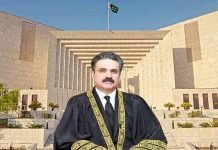
MULTAN: Judge is no different from a Qasid if he fails to decide cases in merit and give justice to people said Chief Justice Asif Saeed Khan Khosa, adding, “Only thing that differentiates a judge in a courtroom from a Qasid (peon or helper), is that he decides cases and gives verdicts”.
“Being a judge, I decided that none of the cases will be adjourned in my court. In my court, a case can only be adjourned on two conditions, if a lawyer dies or if a judge passes away”, the Chief Justice said while speaking at the Multan Colloquium-2019, held on the topic of ‘Dispensation of Justice: Changing Frontiers’ at the Lahore High Court Multan Bench, by the Multan High Court Bar Association (MHCBA) on Friday. MHCBA President Malik Haider Osman presided over the colloquium, while lawyers read out their papers. The chief justice remarked,
Khosa urged young lawyers to not only protect the past rich traditions of legal fraternity but also pass it on to the next generation, as not keeping up with past traditions is the major cause of decline in lawyers’ profession. He said lawyers should be committed to their profession to keep intact the relationship between a client and a lawyer.
The chief justice refreshed his memories when he was a practicing lawyer in Multan with Dera Ghazi Khan district as part of the Multan division. He said those were great times of rich traditions, when he spent time with senior lawyers and learnt a lot from them. He said today there is no bond of mutual respect between senior and junior lawyers, which was the core value in the past. When the tradition of mutual respect was alive, never any incident of frustration occurred in the courtroom. But now frustration is visible during day to day court proceedings due to ignorance of rich traditions of the past, he added.
The CJ said that the situation had brought imbalances in the profession. No lawyers want in-depth pleading of a case, but shortage of judges, who are overburdened with cases, demands precise presentation of arguments. This situation increases frustration among lawyers. The second imbalance is related to mushroom growth of law colleges and induction of fresh law graduates in the profession. Seniors are not available in the profession to meet the number of fresh law graduates each year. There was a practice in the past that junior lawyers used to spend five to six years with their seniors before starting their career independently.
The CJP said that now the situation is that junior lawyers have their juniors in the profession, who have no proficiency and link with the past traditions and they are creating problems in the profession. The junior lawyers lack opportunities to learn from their seniors.
The CJ said bar associations should play their role in minimising the imbalances and arrange trainings for young law-graduates, which should be compulsory before starting independent practice. He said he spent 40-45 years in law profession and he was feeling deeply about transfer of the past traditions to juniors.
The CJ highlighted three basics to become a good lawyer, including proficiency in history, mathematics and literature. When a lawyer is drafting his petition, he must care about the history and be aware of law interpretations, made by superior judiciary from time to time. A lawyer needs solid quotes from the history, so he must be proficient in history, he added. A lawyer needs to furnish arguments in his petition, so he must be proficient in mathematics to prove his stance in his petition. A lawyer uses variety of words in his petition and he would not do it until he has proficiency in literature.
The chief justice said that often they use an incomplete sentence that bars and benches are two wheels of cart, but there is a third character of horse in the cart and he is the litigant. The lawyers must care about the interests of litigants, he added.
The Chief Justice said the number of lawyers in the country was increasing, but the standard of their abilities was declining at the same time.
“Judges used to have less number of cases which was why lawyers would not complain that a judge didn’t listen to them in detail,” Chief Jusice Khosa said.
“Now judges are unable to listen to lawyers at length due to a plethora of cases.”
He said judges at present try to announce as much verdicts as they can.
The chief justice recalled the time when he appeared before the Multan High Court bench as a lawyer in 1981.
“A teacher-student bond used to exist here and everyone was quite respectful of others,” he said. “One should be thinking as to why the circumstances are not the same today.
“The number of lawyers is definitely increasing but the standard is declining,” Chief Justice Khosa added.
Courtesy TNI
Read more: