By Shakil Durrani
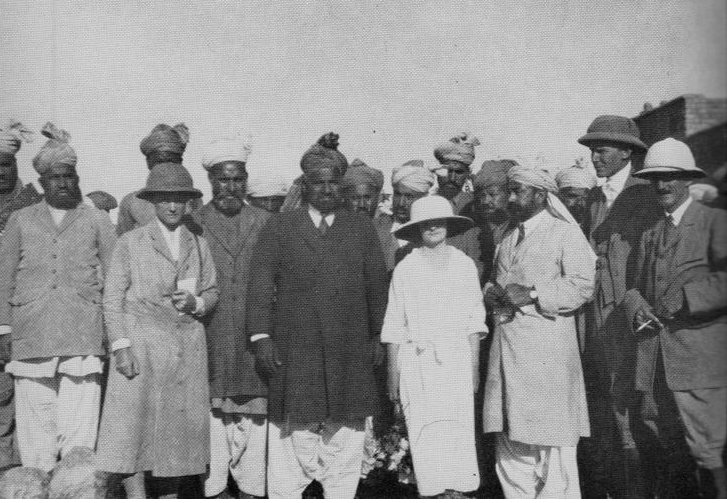
A hundred years back on 14 April 1923, a sixteen-year English girl, Mollie Ellis – the daughter of Major Ellis – was kidnapped from Kohat by Afridi tribesmen but was soon recovered unharmed. A gang of Adamkhel Afridis of Darra, led by Ajab Khan and his brother Shahzada were suspected of conducting thefts and raids in nearby Kohat town. A contingent of Frontier Constabulary took preventive measures through a ‘barampta’ raid to arrest those responsible.
It was feared that the main accused would flee the house wearing women’s clothes. The Constabulary therefore started checking all inmates, which included some women who were leaving. Ajab Khan considered checking the women insulting and an affront to local conventions. He promised revenge and shortly thereafter led a gang at night who entered the house of Major Ellis in Kohat Cantonment. The Major was away on military exercises but his wife, on hearing footsteps, blew the whistle provided for such an emergency. To prevent the alarm being raised, Shahzada stabbed and killed Mrs Ellis and forcibly took away Mollie.
On being led away she recognized the surrounding hills, spotting the peak locally called the ‘old woman’s nose’. The gang travelled westwards towards the Orakzai tribes finally taking refuge with the Mamuzai tribe. The Akhunzada of Mamuzai was a spiritual leader of great significance and enjoyed wide esteem. This was a lucky break for Mollie.
The kidnapping of an English girl from the well-protected cantonment was deeply humiliating for the government. In response, two Army Divisions started being mobilized. Simultaneously three prominent Pakhtun government officials – Sheikh Mahboob Ali, Quli Khan Khattak and Mughal Baz Khan Afridi – organized tribal Jirgas to negotiate her release.
The Chief Commissioner NWFP, Sir John Maffey, personally supervised the recovery effort from Shinawari Fort which was the gateway to the Orakzai tribe.
Once the jirga had established contact with Mahmud Akhundzada, an exceptionally brave volunteer nurse, Lillian Starr from the Mission Hospital, Peshawar, travelled deep into the Tribal Areas with some supplies to comfort Mollie. The devoted efforts of the tribal jirgas coupled with the threat of the army divisions being assembled had the desired result.
Lillian Starr was soon able to bring Mollie back through the Yakho Kandao Pass and was received in great style by the Chief Commissioner and the military officers. Mollie later recalled, ‘my father was waiting. I don’t think we said a word, we just fell into each other’s arms’. She was unharmed and unmolested to the great relief of everyone as mentioned by Lillian Starr in her book, Tales from Tirah and Lesser Tibet. ‘I knew the Pathans didn’t molest women. They’d kill you, but they wouldn’t molest you’. The Pakhtun kidnappers behaved ‘honourably’ on this count.
Mollie and her father returned to England, after Mrs Ellis’s burial in Kohat cemetery where her tombstone reminds one that life ’tis but a little while’ and no more.
The kidnapping issue, however, did not end with the return of Mollie, as the British administration made sure that they punished the gang by exiling them all to northern Afghanistan and then razing their houses in Darra Adamkhel to the ground. One from the gang was arrested, tried and executed. Ajab Khan and Shahzada died natural deaths in Afghanistan. Later I was informed that six persons from their family were killed resisting the Soviet occupation of Afghanistan; the rest arrived in Pakistan as war refugees.
In 1979, when the author was in England for an advanced degree course, Mollie Wade was contacted through the courtesy of the grand old man of the Frontier, Sir Olaf Caroe, the last British Governor of NWFP. (His reply was deeply moving, mentioning his pleasure in writing to a ‘Durrani’, the ‘rulers of Afghanistan from Ahmad Shah to Zahir Shah and Sardar Daud’).
I then travelled to Suffolk to meet her. She was quite frail by then. In one breath she spoke of the sad events of the early part of the century and then in the next switched to apples growing in her small garden. She did wonder how ordinary people through sheer chance could shape history and how many thousands could have been killed as a result. She provided me with a penned-down version of her accounts. She still felt the pain of her mother’s murder after all those years and was angry with some of the film producers for falsifying her role in the tragedy.
After sixty years, ‘a little while’ later, Mollie Wade née Ellis visited Pakistan, mainly to see her mother’s grave in Kohat cemetery. A new tombstone was created from a photograph provided by Mollie. Brigadier Zafar Hayat, a former hockey Olympian, then posted in Kohat, also placed a tablet commemorating her visit.
Later, the Khyber Rifles in Landikotal invited her to an elaborate tribal lunch in their mess – complete with a pipe band and its accompanying protocol. There I learnt of a dinner invitation for Mollie from the Governor of NWFP, Lt. General Fazle Haq. Someone not very familiar with her, had planned to act as the great re-conciliator and suggested to the Governor to invite both Mollie and the sons of Ajab Khan who were living as Afghan refugees in Pakistan to this dinner. The Governor was thrilled and looked forward to a historic handshake which would end sixty years of rancour. I was not so sure about her response. When she was informed of the proposed dinner invitation she unapologetically declined to meet or shake hands with the family members of those who had caused her so much grief. The dinner was attended only by Mollie.
Close to a century later, the event can be seen in different contexts as neatly spelled out in the words of the historian Elizabeth Kolsky. ‘From the colonial perspective, the kidnapping was seen as an “outrage” that demonstrated the lawless savagery of the tribes who inhabited this strategically significant Indo-Afghan borderland. From the local perspective, the kidnappers led by Ajab Khan Afridi were valiant heroes who boldly challenged an alien and oppressive regime. In the British empire, the idea of the frontier signified a racial line dividing civilization from savagery. This space defined the colonial system where ‘no signs of weakness’ could be shown. (Edited By Khadijah Kamili)
Shakil Durrani served as Commissioner Kohat and Chief Secretary NWFP (KP). His memoir ‘Frontier Stations’ has been published by OUP. He can be reached at markhornine@gmail.com.
Also Read: Afghan female students, lecturers protest in Kabul against Taliban’s closure of varsities